10 Tips for Selling Graded Cards More Effectively
Practical strategies to price, photograph, time, and list graded cards, plus vault syncing and analytics to boost sale value.

10 Tips for Selling Graded Cards More Effectively
Selling graded cards can be highly profitable, but only if you approach it with the right strategies. Here’s what you need to know to maximize your returns:
-
Research Prices Before Listing: Use tools like eBay’s Sold Items filter and PSA Price Guide to stay competitive. Auction sales often close 14% lower than "Buy It Now" prices.
-
Highlight High-Grade Cards: Start with PSA 9 and PSA 10 cards, as they fetch significantly higher prices. For example, a raw card worth $10 can sell for $85–$120 as a PSA 10.
-
Self-Grade Cards First: Assess surface, centering, corners, and edges before paying for professional grading. Only submit cards you believe will get a PSA 9 or 10.
-
Focus on Eye Appeal: Highlight visual strengths like centering and sharp corners in your listing. Use high-resolution photos to build buyer trust.
-
Use ShowVault for Inventory: Centralize your collection from PSA, Alt, and Fanatics vaults. Track values, manage listings, and simplify sales.
-
Leverage Public Storefronts: ShowVault lets you share your entire inventory via a single URL, saving time and effort.
-
Track Sales Performance: Use analytics to monitor trends, identify top-performing cards, and adjust pricing based on demand.
-
Connect Vaults: Sync platforms like PSA, Alt, and Fanatics to streamline inventory management.
-
Use Quality Photos: Clear images showcasing centering and corners are essential for building trust and attracting buyers.
-
Time Your Sales: Sell during peak demand periods, such as playoffs, holidays, or tax refund season.

1. Research Current Market Prices Before Listing
Market Trends and Pricing Accuracy
When pricing graded cards, it's crucial to base your decisions on current sales data. A great starting point is eBay's Sold Items filter, which shows actual sales from the past 90 days. This approach ensures your pricing stays competitive and aligned with market trends.
"Searching for recent sales is the single most important step to take as you begin pricing your card."
For a deeper dive into values, the PSA Price Guide is a goldmine of information, tracking over 486,427 certified collectible prices across both sports and non-sports categories 8. Similarly, eBay's Price Guide offers live updates, refreshing values every few minutes based on ongoing sales activity 2, 10.
When researching, don’t just rely on listed prices. Tools like 130point.com can help you uncover actual Best Offer prices, which eBay often hides behind strike-throughs 11, 3. Keep in mind that auction sales typically close at about 14% lower than Buy It Now listings 11, 3.
For cards with high potential value, check the PSA Population Report. Cards with a "low pop" (fewer than 100 copies graded PSA 10) often fetch higher prices that general guides may not account for 8, 1. A PSA 10 grade can elevate a card's worth significantly - sometimes multiplying its raw value by 3x to 20x or more 1.
2. Feature High-Grade Cards First in Your Listings
Card Grading and Presentation
When creating your listings, start with your PSA 9 and PSA 10 cards. These high-grade cards are incredibly popular among serious collectors because of their premium value and quick turnover. A PSA 10 grade can amplify a card's worth multiple times compared to its raw, ungraded counterpart 1.
The difference in value between grades is striking. For example, in September 2025, raw Victor Wembanyama 2023 Topps Chrome Rookie cards sold for around $10, while PSA 10 "Gem Mint" versions were fetching prices between $85 and $120 1. That’s nearly a 10x increase, driven solely by the card's grade.
"A PSA 10 card can be worth exponentially more than the same card in PSA 8 condition." - Memorabilia Displays 12
This kind of value boost highlights why these grades are so coveted. Interestingly, only about 10% of pack-fresh modern cards manage to achieve a PSA 10 grade 1. That rarity makes them especially attractive to collectors looking to build top-tier sets. Featuring these cards prominently in your listings not only grabs attention but also aligns with strategies to maximize returns in the graded card market.
For cards with PSA 10 populations below 50 or 100, include population report data in your description 1. This "low pop" status creates intense demand and supports premium pricing that standard price guides might not fully reflect.
3. Self-Grade Cards Before Professional Submission
Card Grading and Presentation
Before spending $18.99–$24.99 per card on professional grading, take the time to evaluate your cards at home. Professional grading focuses on four key areas: Surface, Centering, Corners, and Edges 1, 6. By assessing these yourself, you can decide whether a card is worth the investment, especially if it has the potential to achieve a PSA 9 or 10.
Start with the surface. Use a bright light (at least 60 watts) and a 10x–12x jeweler's loupe to inspect for scratches, print lines, gloss loss, creases, or tiny print dots that might not be visible to the naked eye 13, 1. For centering, check if the image is evenly placed on the card. Ideally, it should have 50/50 centering, though some grading services may accept up to 60/40 for high grades 7, 6. Examine the corners to ensure they are sharp and free from rounding or fuzziness. Finally, inspect the edges for any signs of chipping or color wear 13, 1.
"You must leave any emotional, sentimental or financial involvement out of any assessment." - Rob Bertrand, Cardboard Connection 13
Why is self-grading so important? Consider this: In October 2023, PSA population reports revealed that out of 19,116 submissions of the 2016 Pokémon XY Evolutions holographic Charizard, only 496 achieved a PSA 10 grade 6. That’s less than 3%, largely due to manufacturing quality issues. This highlights the importance of submitting only cards you’re confident will earn a PSA 9 or 10, as lower grades often sell for less than ungraded cards 1.
4. Emphasize Eye Appeal Beyond the Numerical Grade
Card Grading and Presentation
When selling cards, it’s not just about the numerical grade or competitive pricing - how the card looks can play a huge role in attracting buyers. Two cards with the same PSA 9 grade can have very different levels of appeal. A card with sharper corners, perfect centering, and vibrant colors is likely to sell faster and for a higher price than one that lacks these qualities. This is why it’s so important to highlight the visual strengths of your card when listing it for sale.
Grading companies like PSA evaluate factors such as surface, centering, corners, and edges. Interestingly, a PSA 9 card can sometimes appear flawless to the naked eye because minor flaws aren’t always visible. For example, in September 2025, raw copies of the 2023 Leaf Ben Johns rookie card were selling for over $300, while PSA 10 versions were commanding $1,300+. This price jump was partly due to its limited print run of just 3,935 copies and the fact that many were not stored properly1.
To maximize interest, go beyond just stating the grade in your listing. Instead of simply writing "PSA 9", mention specific features like "perfect centering", "sharp corners", or "original gloss intact." Including high-resolution photos is equally important - show close-ups of all four corners and edges to prove there’s no chipping or whitening4.
For vintage cards, visual appeal can outweigh the numerical grade entirely. Take the 1952 Topps Mickey Mantle card as an example: a PSA 2 version might sell for $10,000–$15,000, while a PSA 8.5 can reach over $500,0005. Even buyers of lower-grade vintage cards focus on qualities like strong color and minimal creasing, as these features make the card more desirable overall.
5. Use ShowVault to Sync Multiple Vaults and Track Inventory
Simplifying Vault Management
Keeping track of cards stored across multiple vault platforms can quickly become a hassle. If your collection spans PSA, Alt, and Fanatics, you're likely juggling three different apps just to check your inventory. Each platform comes with its own set of tools, forcing you to switch back and forth. This scattered setup makes it tough to get a clear view of your collection’s overall value or figure out which cards to sell first. By centralizing your vaults, you streamline storage and create a solid foundation for smarter, data-driven decisions.
Streamlined Inventory and Insights
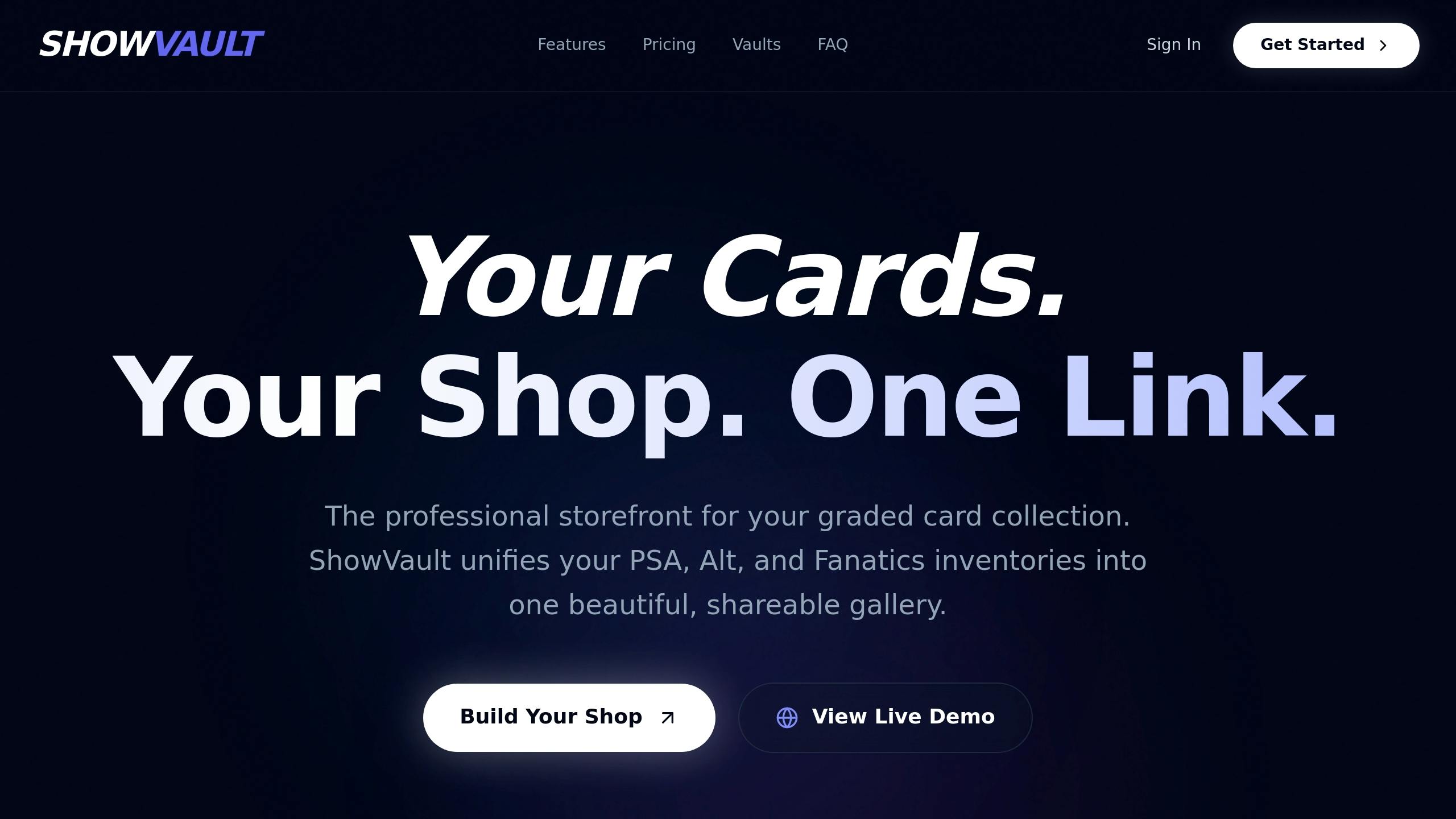
ShowVault tackles this problem by syncing all your vaults into one easy-to-navigate dashboard. With everything in one place, you can quickly review storage details, track your collection's current market value, and identify the best cards to list for sale. This unified approach not only simplifies inventory management but also complements the pricing and selling strategies mentioned earlier. Plus, ShowVault accommodates collections of any size with no tracking limits.
The platform’s analytics dashboard is another game-changer. It lets you monitor sales trends, track which cards are drawing the most attention, and observe how your collection’s value changes over time. You can even export data for deeper analysis. For perspective, the PSA Vault alone houses over 1.6 million items valued at more than $650 million, with over 1.2 million items vaulted and sold through their system 15.
ShowVault also provides a public storefront URL, enabling you to showcase your entire collection to potential buyers without the hassle of creating individual listings. For $24.95 per quarter, the platform includes priority support, making it an efficient tool for anyone serious about selling graded cards with ease.
6. Share Your Collection with ShowVault Public Storefronts
Why Use Professional Vault Platforms?
Listing cards one by one can be a time-consuming hassle. Instead, ShowVault's public storefront feature lets you share your entire inventory with a single URL 14. If your cards are stored in professional vaults like PSA, Alt, or Fanatics, they benefit from high-resolution photography and digitization. These professional images showcase details like condition and centering far better than amateur photos ever could 4.
Simplified Inventory Management
Managing your collection efficiently is just as important as showcasing it. With a public storefront, you can track your collection's value in real-time, all while keeping your cards safe in a secure, climate-controlled environment 4. Buyers get accurate, up-to-date information about your inventory, and you get the convenience of managing everything through a single dashboard.
Grading, Presentation, and Buyer Trust
Selling becomes even smoother with digital transactions. When a card sells from your vault storefront, ownership transfers digitally - no shipping required 18. This not only saves time but also builds buyer confidence. Professional vault platforms enhance your storefront with trust markers like vault badges and authenticity guarantees. These signals reassure buyers that each card has been inspected and accurately described, reducing any doubts 18.
"The process is designed to be effortless, with marketable item details and high-quality photography that attract buyers who value professional authentication." - PSA 4
For just $24.95 per quarter, you can track unlimited cards and maintain a polished, professional storefront - without the headache of creating individual listings.
7. Use ShowVault Analytics Dashboard to Track Sales Performance
ShowVault's Analytics Dashboard takes the guesswork out of managing and selling your card collection by transforming raw data into meaningful sales insights.
Inventory Management and Analytics
Keeping tabs on your graded card portfolio has never been easier. The ShowVault Analytics Dashboard pulls together your entire inventory from PSA, Alt, and Fanatics vaults into one streamlined view. But it doesn’t stop at simple organization - it digs deeper, offering a breakdown of individual card performance. You can track your total portfolio value, monitor how specific cards are performing, and uncover detailed trends, all in one place.
What makes this tool even more impactful is its ability to continuously update your collection's market value using real-time transaction data - not outdated price guides 19. When managing hundreds or even thousands of cards across multiple vaults, this level of consolidation and real-time tracking becomes crucial. It helps you pinpoint which parts of your collection are gaining value and which might be losing steam.
Market Trends and Pricing Accuracy
Successful sellers know that pricing cards correctly means staying in tune with the market. The dashboard keeps you ahead by analyzing sales velocity - how quickly similar cards are selling - so you don’t base your pricing on outdated or misleading data 2. For instance, if you notice a rookie card’s sales velocity slowing over the past month, you can tweak your pricing strategy before the market moves further away.
Another powerful feature is its integration with PSA Pop Report data. This helps you identify "Population Plays", where cards with PSA 10 populations under 100 often fetch premium prices. The dashboard highlights these opportunities within your inventory, giving you a competitive edge 1. And all of this is available for just $24.95 per quarter, making it an affordable way to gain high-level market insights.
With these tools, you’re equipped to refine and elevate your sales strategy.
8. Connect PSA, Alt, and Fanatics Vaults Through ShowVault
Simplifying Vault Management
Juggling multiple vault platforms can be a hassle. Take the PSA Vault, for instance - it holds over 1,600,000 items with a combined value of more than $650 million15. Without a centralized system, you'd need to log into each vault individually to track your collection, which can feel overwhelming.
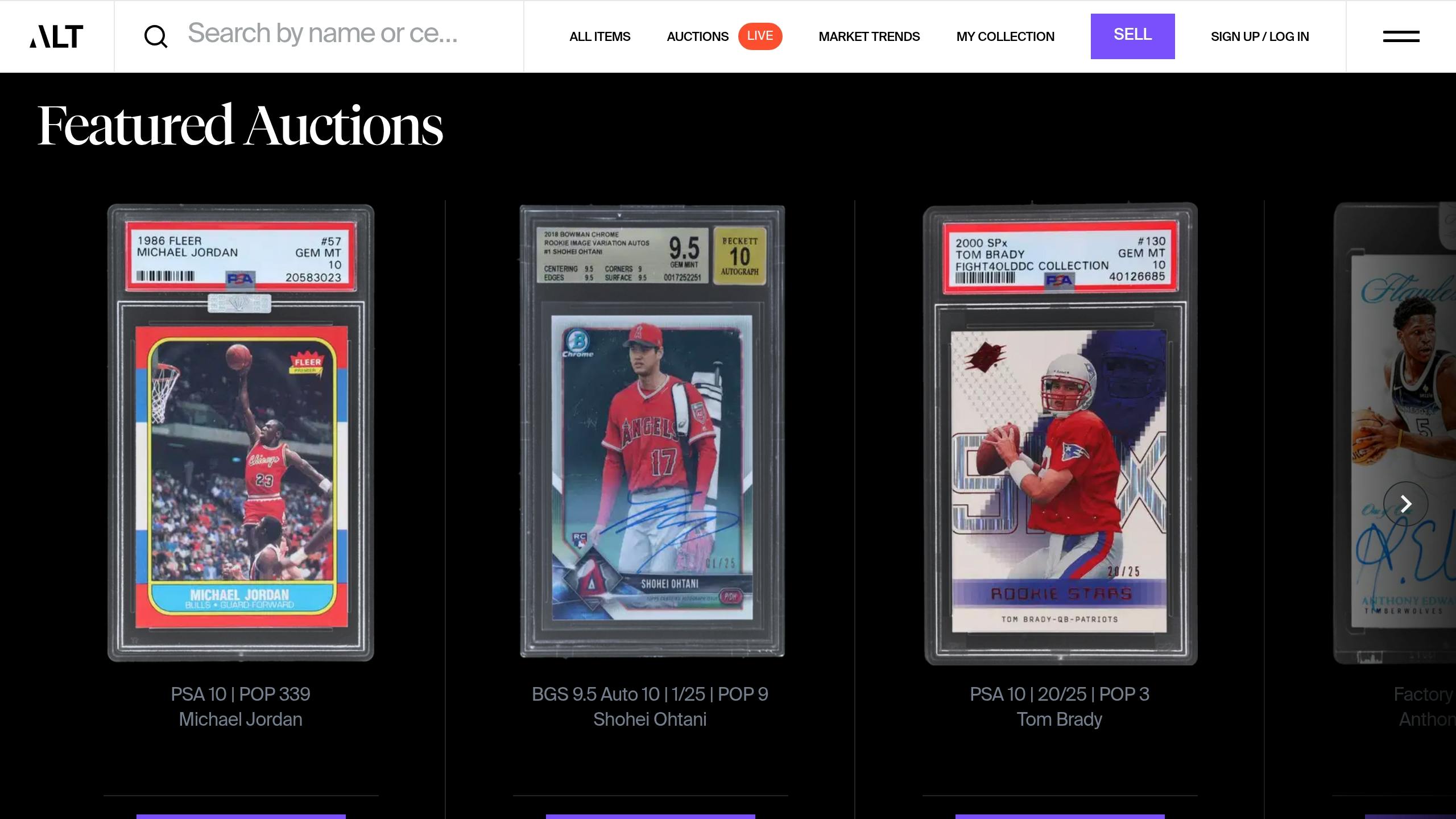
ShowVault solves this problem by bringing your PSA, Alt, and Fanatics vaults together in one easy-to-use dashboard. This integration eliminates the need to switch between platforms, offering a seamless way to manage your collection. Considering that over 1,200,000 items have already been vaulted and sold through the PSA ecosystem alone, this consolidated approach makes managing your assets far more efficient15.
Smarter Inventory Management and Sales
A unified dashboard does more than just simplify tracking - it helps you make smarter decisions. Professional vaults automatically catalog your cards with high-resolution photos and digital records as soon as they arrive. If you choose the "send to vault" option during PSA or Fanatics submissions, your cards are instantly added to your ShowVault inventory20, 9, 15, 21.
This setup also offers financial perks. Vaults located in Delaware, like PSA and Alt, allow tax-free purchases15, 20. When it’s time to sell, you can list your cards on platforms like eBay without dealing with the hassle of packing or shipping. The vault handles all the logistics for you16, 15, 17. Plus, ShowVault's dashboard provides real-time insights, helping you identify which vault offers the best selling opportunities for specific cards based on current market trends15, 9.
9. Include High-Quality Photos Showing Centering and Corners
Card Grading and Presentation
When it comes to presenting your cards for sale, high-quality photos are non-negotiable. Clear images not only showcase the card's condition but also build trust with potential buyers. Details like centering and corner quality are key factors in determining a card's grade and value. As Matt Felumlee puts it:
"Good images means more sales and higher prices. More importantly, strong images are good ethical practice. When buyers have confidence that your pics tell the truth about a card, you earn trust and loyalty." 23
Make sure to photograph both the front and back of the card. Often, imperfections like edge whitening or corner dings are more noticeable on the back [48, 49]. For spotting subtle flaws, use a 10x loupe and tilt the card under a bright light to reveal surface scratches or print lines 25.
Lighting can make or break your photos. A 5000K LED bulb works best to mimic the clean, white tones of professional scanners 24. Position the card vertically in a stand to minimize glare and reflections from the plastic slab 24. Avoid using a camera flash - it can create harsh, washed-out spots that obscure important details 24.
Utilizing Professional Vaults for Imaging
If photography isn’t your strong suit, professional vaults offer a hassle-free solution. These services automatically take high-resolution images with optimal lighting and neutral backgrounds as soon as your cards are received. For instance, the PSA Vault has earned a 100% positive review rate across more than 37,000 eBay sales, thanks in part to its top-notch imaging 22.
If you’re handling the photography yourself, a smartphone with at least a 12-megapixel camera will do the job. Use a clean, dark background to keep the focus on your card and its grading label. Crop the image to remove any distractions [47, 48]. Susanna from QP Market Network emphasizes:
"Take clear photos of the front, back, and close-ups of all four corners. Be transparent about any flaws you noted in your assessment - it builds buyer confidence." 26
10. Time Your Sales Based on Market Trends and Card Rarity
Market Trends and Pricing Accuracy
Timing is everything when it comes to selling graded cards. Market demand tends to spike during specific periods, like tax refund season (April–June) and the holidays (October–December) 1. On the flip side, January through March usually sees lower submission volumes but often quicker grading turnaround times 1.
Each sport also has its own seasonal highs. For example, baseball cards sell best during the October playoffs, basketball cards see a boost around the All-Star break and playoffs, and football cards thrive during draft season in April 1. As for trading card games like Pokémon, the best times to sell align with Q4 holiday shopping and the launch of new sets 27.
If you're selling modern sports cards, pay attention to the "rookie window." This is typically the first two to three years after a player's debut, when demand is at its peak before graded populations grow too large and prices drop 1. A great example of this is the 2023 Leaf rookie card of pickleball player Ben Johns. Initially sold at $7.99, raw copies skyrocketed to over $300, and PSA 10 slabs hit $1,300+. Why? A limited print run of just 3,935 cards made it highly sought after 1.
Understanding these cycles can help you plan your sales strategy to match market demand and maximize profits.
Inventory Management and Analytics
High-grade scarcity equals higher profits. Cards with fewer than 50 to 100 PSA 10 examples tend to command premium prices, no matter the broader market conditions 1. This scarcity creates an opportunity to capitalize on higher sale values.
Tools like ShowVault's analytics dashboard can be a game-changer. By tracking Alt Value metrics and population data, you can pinpoint the best times to list your cards. Pairing this data with your inventory insights allows you to plan strategically and list your cards when demand is at its peak 4, 28.
Using these timing strategies as part of your overall sales approach ensures you're consistently setting up your listings for the best possible returns.
Conclusion
The strategies discussed - ranging from thorough market research to leveraging high-quality visuals and centralized vault management - work together to improve your graded card sales. Selling graded cards successfully takes careful planning, good timing, and the right resources. By staying on top of market prices, highlighting your highest-grade cards, and pairing numerical grades with eye-catching visuals, you can create stronger buyer interest. Including clear, detailed photos that showcase centering and corners builds trust with potential buyers, while timing your listings around seasonal trends and market demand ensures you’re selling when interest is at its peak.
Managing your inventory efficiently is just as important. Instead of juggling multiple tools and platforms, solutions like ShowVault allow you to sync your PSA, Alt, and Fanatics vaults into one streamlined dashboard. This centralized approach simplifies inventory management, making it easier to stay organized and focused on selling.
Top sellers rely on data to guide their decisions. By monitoring key metrics like population reports and recent sales comps, you can pinpoint the best times to list and refine your approach for better results. This data-driven strategy turns grading and selling into a more precise and informed process.
ShowVault’s public storefronts and analytics dashboard make it easy to share your collection, attract buyers, and track your performance - all while saving time and boosting profitability. Combining these tools and strategies creates a smoother, more efficient selling experience that helps you maximize your returns.
FAQs
When is it worth grading a card before selling?
Grading can be a smart move if it might boost a card's value significantly. It's best to focus on sought-after cards, such as rookie stars, iconic inserts, numbered parallels, or pop culture favorites that are in top-notch condition. Look for features like sharp corners, a clean surface, and precise centering. However, keep in mind that grading costs can vary widely, from around $12 to over $300. Make sure the potential value increase justifies the expense. If the card’s condition or market demand doesn’t support grading, selling it raw might be the better option.
What photos do buyers need to trust a graded card listing?
Buyers rely on clear, high-quality photos to make informed decisions. Make sure to capture the card’s front, back, edges, serial number, and any visible imperfections. These details build trust by offering transparency and allowing buyers to evaluate the card's condition with confidence.
How do I decide whether to sell via auction or Buy It Now?
When deciding between auction and Buy It Now (BIN) listings, it all comes down to your objectives and the market dynamics. Auctions work best for rare or highly in-demand cards. They can lead to higher prices if bidding heats up, but there’s always the chance of receiving lower bids. On the other hand, BIN listings give you more control and consistency. In fact, they often fetch 10-14% higher prices compared to auctions, particularly for common cards with clearly defined values.
Sources
1. https://resellcalendar.com/news/reselling-101/psa-card-grading-strategy-guide-reseller-2025
2. https://www.ebay.com/sellercenter/selling/selling-trading-cards
3. https://cardlines.com/how-to-sell-sports-cards-on-ebay
4. https://psacard.com/info/psa-vault
5. https://www.justcollect.com/should-i-grade-my-cards
6. https://resellcalendar.com/news/reselling-101/how-to-grade-cards-a-resellers-guide
7. https://www.fanaticscollect.com/pages/how-to-grade-and-store-your-graded-trading-cards
8. https://www.psacard.com/priceguide
9. https://www.fanaticscollect.com/how-to-grade
10. https://www.ebay.com/sellercenter/selling/what-to-sell/selling-trading-cards
11. https://cardlines.com/how-to-price-your-ebay-auction
13. https://www.cardboardconnection.com/pre-grade-sports-cards-results
14. https://support.alt.xyz/en/articles/9213547-collection-management
15. https://www.psacard.com/info/psa-vault
16. https://www.stackingslabs.com/episodes/vaulted-how-i-sold-14-cards-through-the-psa-vault-on-ebay
17. https://www.psacard.com/info/consignment-rates
18. https://www.ebay.com/help/selling/trading-cards-listing-tools/using-the-ebay-vault?id=5342
19. https://blog.justcollect.com/blog/sell-your-psa-graded-set-to-just-collect
20. https://support.alt.xyz/en/articles/9213530-the-alt-vault
22. https://www.cardlens.com/blog/sports-card-vault-comparison
23. https://cardhoundvintage.com/how-to-take-great-sports-card-pictures
24. https://gradedcardinvestor.com/take-awesome-pictures-of-sports-cards-for-ebay
25. https://figoca.com/blog/grading/how-to-select-cards-to-submit-for-grading
26. https://www.qpmarketnetwork.com/trading-card-game/how-to-sell-trading-cards
27. https://www.pokemonpricetracker.com/blog/posts/pokemon-card-price-over-time